Inventory completeness
Spot unmanaged devices and shadow services that never made it into CMDB records.
Network discovery + security auditing
Nmap is a widely used network discovery and security auditing tool. It helps teams understand what devices are reachable, which services are exposed, and how an infrastructure footprint changes over time. This guide explains the concepts and the responsible, authorized contexts where Nmap-style discovery is applied.

Network discovery and security auditing are core to infrastructure hygiene. Teams use Nmap-style scanning to understand their environment, verify access boundaries, and keep service availability aligned with policy.

Security auditing is not a one-time scan. It is a repeatable loop for visibility and control.
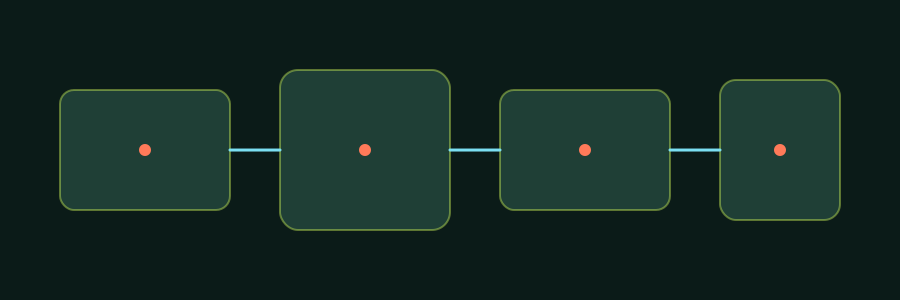
Identify reachable hosts and services within a defined, approved scope.
Capture service identity and exposure context for auditing.
Detect drift against known inventory, baselines, or policies.
Confirm remediation and validate service availability targets.
Discovery is only useful when it translates into clear, actionable signals.
Spot unmanaged devices and shadow services that never made it into CMDB records.

Track changes in open ports and access tiers between deployment windows.

Provide evidence that security auditing is continuous and scope controlled.

Use discovery signals to align service availability goals with security posture.
Clear, responsible guidance about network discovery and security auditing.
No. This is an independent guide. Nmap is a trademark of its respective owner.
Yes. It is commonly used to find reachable hosts and assess exposed services for auditing.
Network inventory, service availability checks, exposure mapping, and change validation.
No. Always use Nmap only on assets you own or have explicit authorization to assess.
Share your environment context and we will outline responsible, authorized discovery practices aligned to your governance requirements.
Email: [email protected]
Phone: +1 (470) 555-0196
Address: 415 Sentinel Yard, Atlanta, GA 30308, USA
Mon-Fri: 09:00-18:00 ET
Response time: within 1 business day